
What candle waxes are available, how do they differ, and which one should you choose?
Candle making is a creative process, yet often full of challenges: once the idea of the final result is ready, all that’s left is to choose the materials to work with. At this point many questions arise—what waxes exist, what are their properties, how do they differ, and ultimately—which one to choose? At “Candle Paradise” various waxes are available. Check out our candle-wax selection —
Before we look at some of the most popular waxes, it’s worth noting that waxes fall into two major categories:
- Waxes for container candles — meant for candles poured into vessels such as glasses, jars, pots, and other containers. They ensure even, durable adhesion of the wax to the container walls.
- Waxes for pillar candles — meant for free-standing candles usually placed on tables and in candleholders. To make these candles, polycarbonate, metal, or silicone molds are used. These waxes are oilier and ensure the candle can be easily released from the mold.
Beeswax is the only wax that does not fit this division. Due to its distinctly natural origin, it can be used only for pillar candles.
If you try to use pillar wax for container candles, the candle may develop visual defects (the wax will pull away from the container walls) and the candle might even fall out of the vessel.
Conversely, if you use container wax for pillars, you won’t be able to demold the candle, as it will adhere to the mold walls as it cools.
SOY WAX
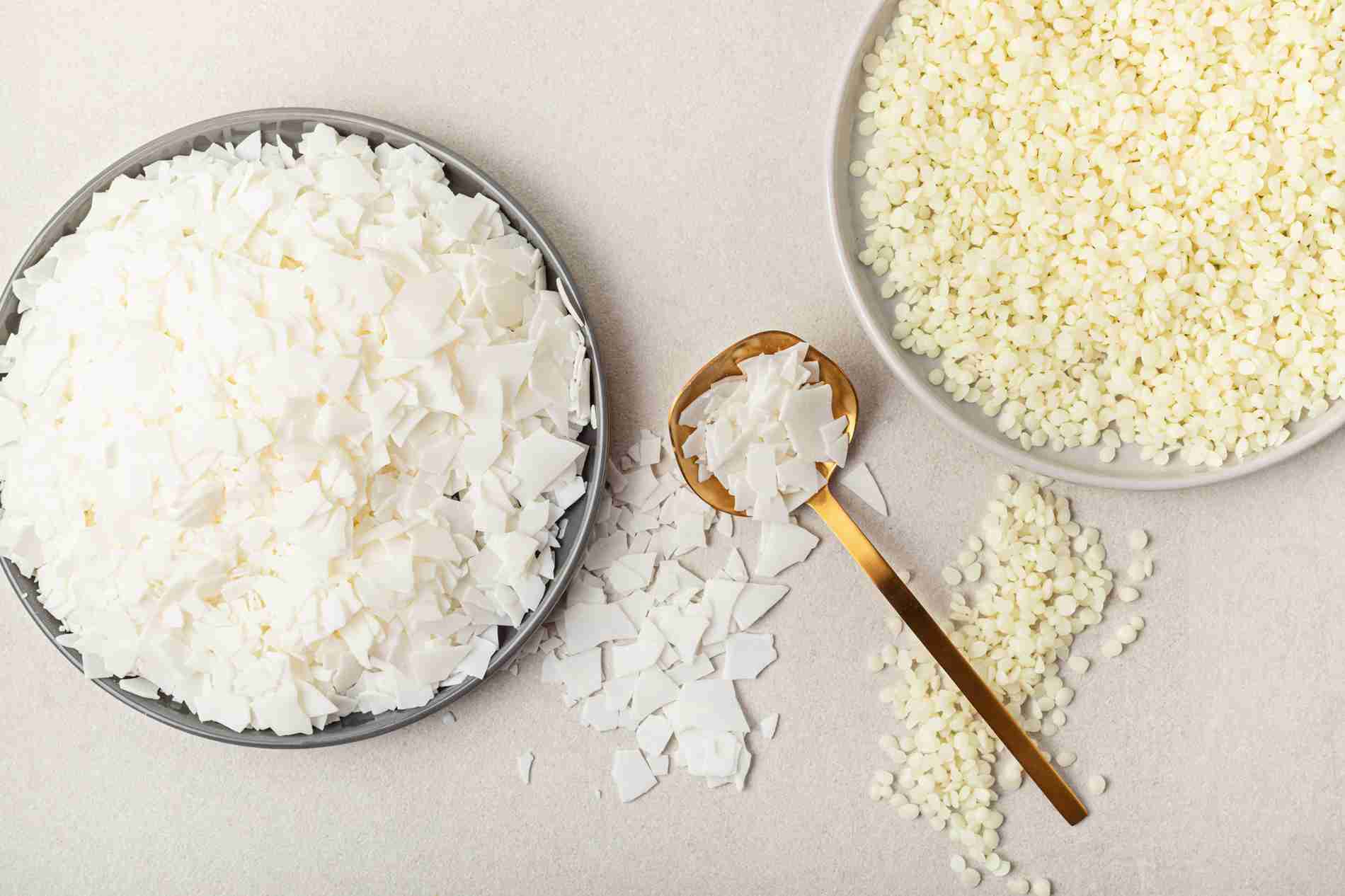
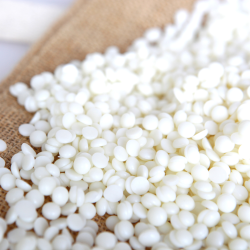
Soy wax has rapidly gained popularity. It is a natural wax obtained from hydrogenated soybean oil; it comes in flakes or pellets, is white-creamy in color, and has no scent.
Advantages of soy wax:
- Completely natural and renewable resource.
- Fully biodegradable.
- Contains no toxic substances that could harm health.
- Soy-wax candles burn twice as long as classic paraffin candles.
- Spilled wax cleans up easily with water and soap.
- Candles burn slowly and calmly, without smoke or soot.
Disadvantages of soy wax:
- Large-scale cultivation raises concerns about deforestation and pesticide use.
- Considerably softer than paraffin, stearin, and palm wax, which makes producing well-burning pillars (in molds) more challenging.
Most in-demand soy waxes:
- For containers — Kerasoy Container 4130 and the cheaper GoldenWax S41.
- For pillars — Kerasoy Pillar 4120 and the new Keragreen Soy Pillar. However, if you want the highest quality and ease of use, we recommend EcoSoya PillarBlend!
PARAFFIN
The most popular wax historically is paraffin — a petroleum-derived product consisting of a mixture of hydrocarbon molecules; it is white and sold as pellets or slabs.
Most candles sold in stores are made from inexpensive paraffin (the very cheapest is used for outdoor candles): the cheaper the paraffin, the less it has been purified of petroleum-product impurities.
Cheap paraffin produces soot and indoor air pollution, yet keeps candle prices accessible.
In our shop we offer only high-quality, fully refined paraffin, which can even be purer than plant waxes. It’s also used in the food industry, for example to coat cheese with a wax layer.
Advantages of paraffin:
- Price — the cheapest raw material among candle waxes, even when fully refined. The lowest-cost version comes in 5 kg slabs.
- Because of its affordability, paraffin is very popular for hosting candle-making workshops and for producing trench candles for Ukraine.
- Easy to make perfect-looking candles.
Disadvantages of paraffin:
- Not a renewable resource.
- When unrefined, it emits black smoke and harmful soot.
- Difficult-to-remove stains if it contacts surfaces and fabrics.
Although paraffin is very attractively priced, care must be taken when buying it—consider its degree of purity to avoid unpleasant surprises when the newly made candle is burned.
The most popular and cheapest refined paraffin widely used, including for trench candles, is China-made FUSHUN 56/58, available in 5 kg slabs.
Of course, pellets are more convenient — Kerawax 485 for pillars and Kerawax 4140 for container candles!
STEARIN
Stearin, also called tristearin or glyceryl tristearate, is a white, odorless powder. It’s obtained from tropical plants such as palm.
Stearin can be used on its own to make 100% stearin candles or added to other waxes to give the candle hardness and rigidity.
Stearin candles are smooth with a slightly matte yet glossy surface; when burning, a beautiful “frost-flower” lattice can form along the edges.
Only for pillars or as an additive (especially to paraffin) to add hardness and rigidity.
COCONUT WAX
- Also a fully natural and renewable resource.
- This candle material contains no genetically modified ingredients, is vegan-friendly, and harmless to nature — it’s fully biodegradable.
- Bright white color, smooth surface, and a beautiful sheen.
- Often blended with other natural ingredients to improve burning quality.
- Like soy wax, easy to clean from surfaces.
- Suitable for container candles; often mixed with soy.
- Sensitive to overheating!
PALM WAX
- Palm wax is obtained from carnauba palm oil. You can make single-color candles from it, but it’s especially known for creating beautiful crystalline patterns throughout the candle as it sets.
- After harvesting palm leaves, they are dried and pressed to obtain wax, which is then purified and bleached. This palm is also known as the “queen of waxes.”
- Palm-wax candles form various patterns that look particularly striking when burning in the dark. This wax also excels at holding and dispersing fragrance.
- Although it is a renewable resource, mass production of palm wax raises concerns because forests where these palms grow are being widely and rapidly cleared.
- Palm-wax candles are hard and bright-burning; during burning, a thin lace-like wax edge forms along the sides.
- Palm-wax candles burn much longer than paraffin ones. Palm wax is 100% ecological and renewable, and it is hypoallergenic.
BEESWAX
Beeswax is a natural material produced by the glands of honeybees. It is yellow (from pale to dark yellow, depending on the degree of purification) and has the characteristic beeswax aroma.
Most often, beeswax candles are not given additional scents or dyes, as their naturalness is the focus.
This is also one of the oldest materials used in candle making. Beeswax is said to carry pure, healing bee energy, which is why beeswax candles have long been used in various rituals, including in churches.
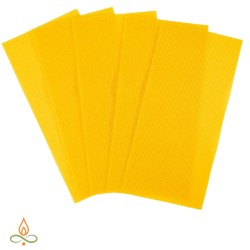
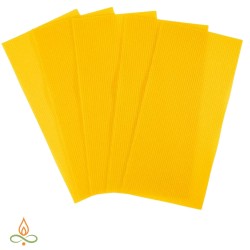
Beeswax comes in three forms — disks (from 100 g to 15 kg), loose granulate, and sheets.
Disks and loose beeswax are melted and poured into silicone molds, or a wick is repeatedly dipped into the wax and dried until the desired candle diameter is reached.
Wax sheets are the simplest and fastest way to make candles at any age — all you need is a wick and a beeswax sheet (you can also buy a ready-made kit).
Advantages of beeswax:
- Completely natural and renewable resource.
- Said to carry pure, healing bee energy.
- Considered to purify and ionize indoor air when burned.
- Has the beloved natural beeswax aroma.
- Beeswax is produced right here in Latvia (for candles) or in Europe (refined cosmetic waxes), so it can be considered a local product.
- Beeswax-sheet (roll-up) candles are very easy to make, even for children.
Disadvantages of beeswax:
- Price — the most expensive of all waxes;
- Distinctly sticky, so it cannot be used in polycarbonate and aluminum candle molds — only in easily opening silicone molds;
- Cannot be used for container candles (in vessels), as it may detach from the container walls upon cooling and cause a visual defect.
RAPESEED WAX
- Rapeseed wax is often called a “local raw material”, as it is predominantly produced in Europe.
- An eco-friendly candle-making material — renewable and fully biodegradable.
- Obtained from rapeseed oil, which is used not only for candles but also in food and cosmetics.
- This material has no specific smell or color and contains no harmful toxins that could be released during burning. Candles also have a comparatively long burn time.
- Especially suitable for container candles and for blends.
- By making or buying rapeseed-wax candles, you help promote European agricultural development.
OLIVE WAX
- Less often discussed but also an excellent natural material that, like coconut wax, is blended with other natural ingredients to achieve the best possible product.
- Can be used for both container and pillar candles in blends—smooth surface, light sheen.
LOOSE POWDER CANDLE WAX
- A very fine, free-flowing wax that is not melted.
- Pour it into a heat-resistant container, fix the wick, and the candle is ready to use.
- Avoid shaking the container!
- Best for container candles in glasses and jars, especially if you want colorful layers or patterns.
- Do not fill the vessel to the very brim, and secure the wick firmly.
GEL WAX
- A transparent, mineral-oil-based gel intended only for container candles.
- Burns slowly and looks very decorative.
- The limitation is to use only gel-safe fragrances and in small doses, and avoid adding easily flammable decorations.
- Choose gel wax if a transparent look with visible details is important.
- Use thick-walled glass and place decorations at a safe distance from the flame.
LAMP OIL (liquid paraffin)
- Specially refined liquid fuel intended for oil lamps, not for classic candles.
- Lamp oil burns evenly and for a long time and is easy to refill.
- Not used for candles, as it’s not meant for pouring into molds or vessels with solid wax.
- Choose lamp oil if you want to use an oil lamp with a reservoir and adjustable wick.
- Use only in manufacturer-specified lamps; do not pour fuel onto a heated lamp; store away from heat sources.
- Refill only at room temperature!
SHEA OIL WAX
- A plant-based wax from shea butter that gives the candle a creamy feel.
- Best used in blends with other plant waxes such as soy, rapeseed, or coconut.
- Particularly useful for massage candles and soft container candles.
- Rarely used alone, as it is soft and, if overdosed, can weaken scent throw.
- Choose this wax as an additive if you want gentler, creamier burning and a pleasant feel on the skin.
SUNFLOWER WAX
- A hard plant wax from sunflower oil, more often used as an additive.
- It makes the candle firmer and helps it keep shape better, especially in warmer weather or wider containers.
- On its own it can be brittle, so it works best in small amounts together with soy or rapeseed for both container and pillar candles.
- Choose sunflower wax if you need more hardness or stability.
- If overdosed, it may slightly reduce scent throw.
Whatever you have in mind — a glass with a gentle aroma or a sculptural candle from a mold — the most important thing is to start and allow yourself to experiment.
Take the wax you’ve chosen, try making one candle, and enjoy the process of crafting and burning it. With each candle your hand will become steadier, the flame more beautiful, and the result perfectly yours.
Choose the right wax for your dream candle, and we wish you every success!
Related Products

Soy wax for container candles, Cargill NatureWax C-3

Soy wax for pillar candles, Kerasoy Pillar 4120

Palm wax, crystallized with stars finishing, Britz BWC 09

Soy wax for container candles, Keragreen Soy C-EU

Paraffin wax for candles, fully refined, FUSHUN 56/58,...

Palm wax, crystallized with feather finishing, Britz BWC 07
Beeswax sheet, 13x20cm, 35g

Soy wax for container candles, Kerasoy Container 4130

Soy wax for massage candles, Kerasoy Massage Container 4115

Palm wax, crystallised with trees finishing, Britz BWC 16
Paraffin for candles, fully refined 56/58, Kerawax 485

Beeswax, 900g
Soy wax for container candles, Golden Wax 464

Palm wax, Britz BW701

Soy wax for container candles, EcoSoya CB-Advanced

Coconut wax for pillar candles, ecococo PillarBlend

Stearin powder wax, EcoSnow Powder

Stearin, Tefacid 1 VL
Soy wax for pillar candles, Keragreen Soy Pillar

Palm wax, Britz BW703
Beeswax sheet, 26x41cm, 95g

Coconut wax for container candles, ecococo ContainerBlend
Beeswax, white, refined, hard

Beeswax candle rolling set, large

Beeswax, white, refined, soft

Olive wax for container candles, ecoolive ContainerBlend
Beeswax sheet, 26x41cm, 70g

Rapeseed wax for pillar candles, Polycerin 9562
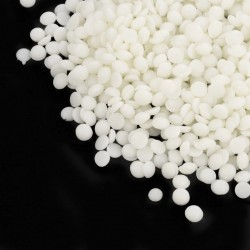
Rapeseed wax for container candles, Polycerin 9512

Olive wax for pillar candles, ecoolive PillarBlend

Shea oil wax for container candles, EcoShea Container
