
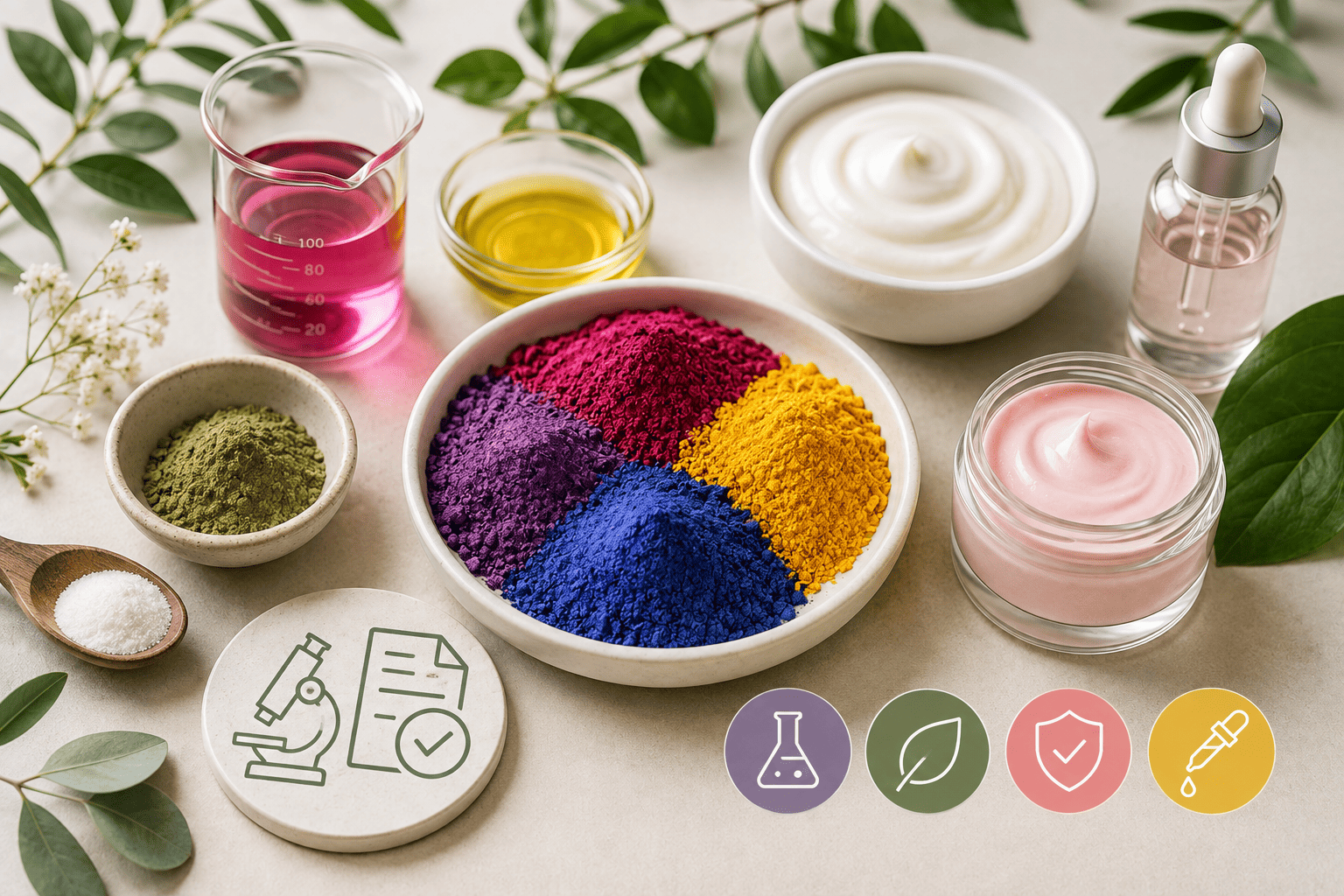
Use of Food Colourants in Cosmetics
Can food colourants also be used when making cosmetics? The short answer is – in some cases, yes. However, the fact that a colourant is approved for use in food does not automatically mean that it is suitable for use in cosmetics.
In the European Union, cosmetic products are regulated by Regulation (EC) No 1223/2009 on cosmetic products. It establishes which colourants may be used in cosmetics and under what conditions.
Can a “food grade” colourant be used in cosmetics?
Being “food grade” is neither a prohibition nor automatic proof that a particular colourant is suitable for cosmetics.
The same substance may be used in different industries – food, cosmetics, pharmaceuticals and others. What matters is the identity, composition, purity, restrictions on use and available documentation for the specific substance.
Therefore, a product being labelled simply as a “food colourant” or having an E number is not sufficient.
1. Check whether the specific colourant is permitted in cosmetics
If a substance is used as a colourant in a cosmetic product, it must comply with Annex IV of EU Cosmetics Regulation (EC) No 1223/2009, which lists colourants permitted for use in cosmetic products.
Annex IV may also specify conditions and restrictions for the use of a particular colourant. It is therefore important to identify the actual substance rather than relying solely on the product's trade name.
2. Determine the exact composition of the colourant
A food colouring product is not necessarily a single pure substance. A commercial colourant may also contain carriers, preservatives, solvents, sugars, anti-caking agents or other additives.
Therefore, the complete composition of the product must be considered, not only the main colouring substance.
3. Request the necessary documentation
To assess whether a raw material is suitable for cosmetic use, sufficient information about the specific product is required. Depending on the substance and product type, this may include:
- product specification or TDS (Technical Data Sheet);
- CoA (Certificate of Analysis);
- SDS (Safety Data Sheet), where applicable to the particular substance or mixture;
- complete composition;
- CAS, EC and/or CI number;
- information about purity and relevant impurities;
- other information required for the safety assessment.
There is no general EU requirement stating that a raw material must carry a “cosmetic grade” label or certificate. What matters is whether the specific raw material actually complies with the applicable requirements and whether sufficient documentation is available to demonstrate this.
4. A finished cosmetic product requires a safety assessment
If a cosmetic product is intended to be placed on the market, it is not enough to establish that a particular colourant is permitted. The finished product as a whole must be assessed.
Under EU requirements, before a cosmetic product is placed on the market it must undergo a cosmetic product safety assessment and have a CPSR (Cosmetic Product Safety Report). The safety assessor evaluates the ingredients, their concentrations, the intended use of the product and other factors relevant to its safety.
So, can food colourants be used in cosmetics?
Yes, this may be possible, but food-grade status alone is not sufficient.
In practice, the assessment should include the following steps:
- identify the exact colourant, its CI/CAS/EC identification and complete composition;
- check whether the colourant is permitted under Annex IV of Regulation (EC) No 1223/2009;
- check any restrictions or conditions applicable to that colourant;
- assess the other ingredients contained in the colourant mixture;
- obtain the necessary technical documentation from the supplier;
- for a cosmetic product placed on the market, assess the use of the raw material as part of the finished product's safety assessment.
Therefore, the statement that cosmetics may only contain raw materials specifically marketed as “cosmetic ingredients” is an oversimplification. At the same time, the opposite assumption – “if it is safe to eat, it must be safe to use in cosmetics” – is also incorrect.
What matters is the specific substance's compliance with cosmetics legislation, its specification, intended use and the safety of the finished cosmetic product.
This article is for informational purposes and does not replace the assessment of a qualified cosmetic safety assessor regarding a specific raw material or cosmetic formulation.