

How the wick works
In this article, we will explain some prevalent questions about wicks. How does a wick work? How can I tell if I have chosen the right wick and if the candle is burning optimally? How should the wick be positioned when the candle is burning?
How the wick works
Let's briefly forget our high-tech age and look at the mechanics of candle flame in a purely scientific way. When we light the wick of a candle, the flame's heat melts the wax. Capillary motion moves this liquid wax up the wick, and as soon as it reaches the tip, it turns into a gas. This releases hydrocarbon molecules.
The molecules break down into smaller molecules that react with each other and with oxygen in the atmosphere. The hot gas and heat released in the reaction zone heat the solid carbon particles to a red glow. It is these carbon particles that produce the pleasantly warm, yellow flame of the candle.
As not all carbon particles are completely burned, some of the remaining particles escape. This produces smoke (small, unburnt carbon particles) or soot residues (large, unburnt carbon particles).
While no candle flame will ever be completely soot-free, the amount of unburnt carbon particles can be reduced by using the best raw materials for candles and a wick made or treated so that it bends easily and reaches the end of the flame where the temperature is highest.
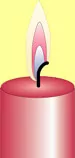
Wick positions -
Ideal wick positionThe wick protrudes from the candle in a straight line and curves towards the flame boundary, entering the “glow zone”, where it burns fully at the highest temperature under the influence of oxygen. |
 |
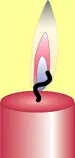
The wick is warped into the shape of a corkscrewThis is either due to uneven tension in the yarn during the braiding process or two yarns with different thread counts. Another possible cause is wick strands plying together before insertion into the candle. |
 |
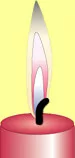
Wick is too thickThe flame is too large for the diameter of the candle and generates soot. |
 |
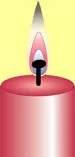
Wick too uprightLarge, residual carbon particles are probably the most widespread and annoying issue affecting the burning performance of candle wicks. The wick does not bend, and its tip fails to reach the outside of the flame, where the temperature is highest and the carbon is burnt completely. Reasons:
|
 |
Wick too thinThe flame melts more wax than the wick can burn. The wax pool fills with liquid wax and ultimately overflows or leaks. |
 |
Wick falls overThe wick has been inserted into the candle too loosely. This happens most frequently with pressed candles if the wick guide is not properly adjusted. It can also happen with cast candles if the wicks have too much space. |
 |
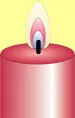
Wick too shortThe wick is damaged due to impurities in the candle material. The flame shrinks, the wax pool fills up with liquid wax, and the candle leaks. In extreme circumstances, the candle might be extinguished. This is due to inorganic contaminants in the wax: hard wax, artificial wax, colourants (especially pigments) and scented oil. |
 |
Wick smokesThis type of soot is generated as a result of drought. Candles should be burned in a draught-free area. |
 |
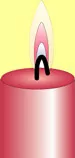
Wick bends too farThis may be caused by soft paraffin (strong penetration) or insufficient wick preparation. A specially treated wick can stand better in soft paraffin than a regularly treated wick. This frequently happens with pressed candles. Normally treated wicks bend too far if used in pressed candles. We therefore recommend using a specially treated, braided wick for pressed candles. |
 |
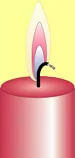
Wick generates residual ashThis ash is generated by contaminations in the wax. The unburnt materials collect at the end of the wick in the form of thin threads or sometimes even a double wick. A special wick treatment can burn a certain amount of contaminants completely. |
 |
Related Products
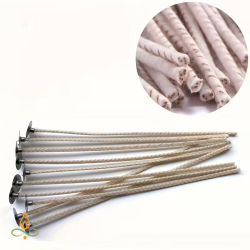
Waxed wick with metal sustainer, ECO
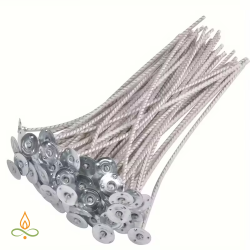
Waxed wick with metal sustainer, TB

Wick sustainer for wood wicks, round

Double wick base for wooden wicks, square

Wick sustainer for wood wicks, square

Wood wick, 20x130 mm

Wood wick, cross, 13x130 mm

Wood wick, 15x150 mm

Wood wick, cross, 10x80 mm
