
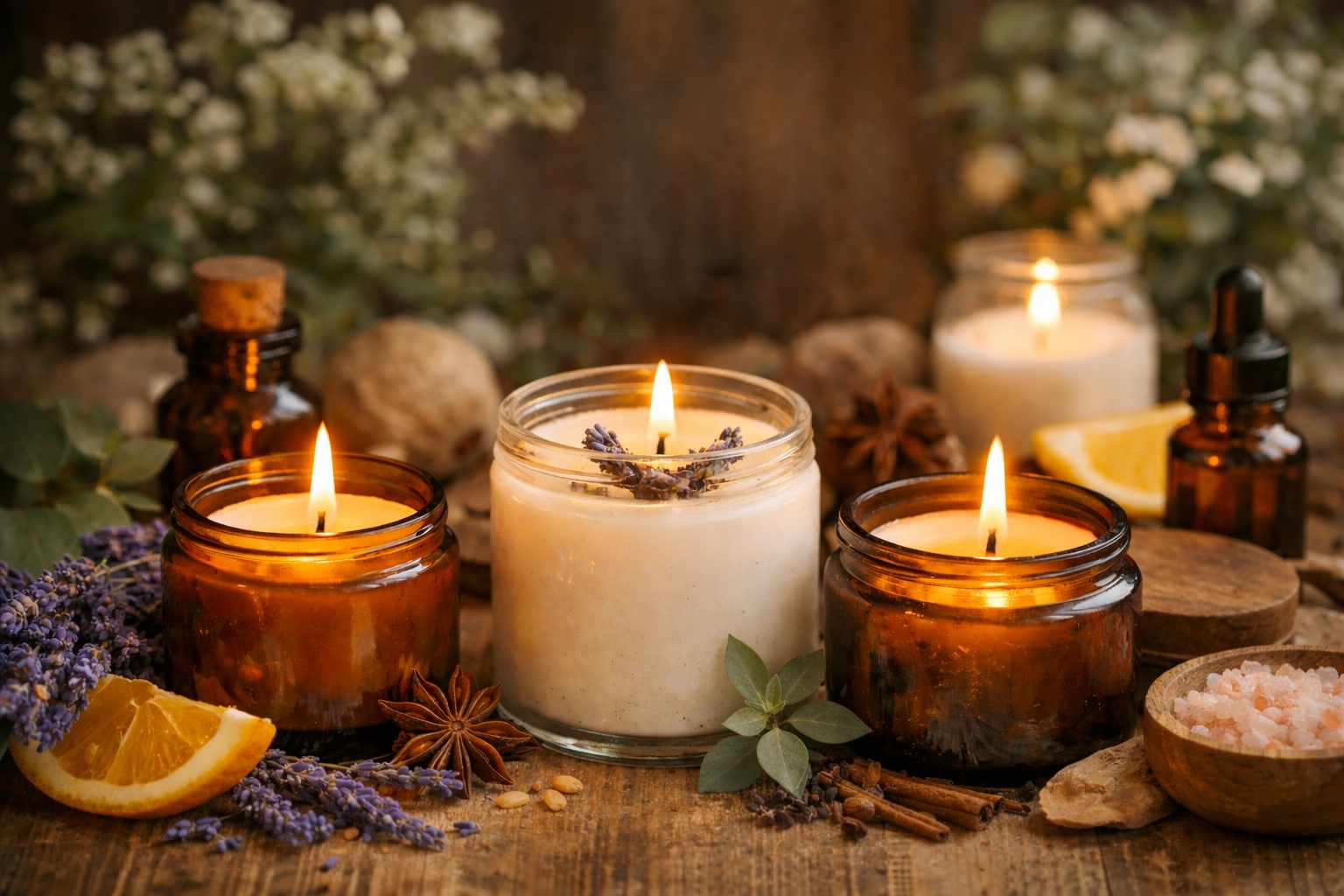
Aromatherapy candles with essential oils: what to do and what not to do
An aromatherapy candle is not just a “nice-smelling candle”. It is a small wellbeing ritual – a moment when, with light and scent, you can change the mood in the room, help yourself relax, focus, or simply make the evening more cosy. However, you should always be careful with essential oils – they are highly concentrated plant extracts, not just an ordinary fragrance.
In this article, we will go through the main “can do” and “better not do” points if you want to pour real essential oils into your candles. As an example, we will use the essential oils offered in our shop – both classic lavender and citrus, and the intense spicy notes that are specially created for candle making.
What exactly is an aromatherapy candle?
An aromatherapy candle is a candle where essential oils are used to create the scent, instead of only synthetic fragrance oils.
Essential oils – natural, highly concentrated plant extracts (lavender, eucalyptus, lemon, pine, etc.) that work through the sense of smell and are often associated with a specific wellbeing effect – calming, invigorating, refreshing, etc.
Fragrance oils – usually blended or synthetic fragrances that are designed specifically for candle scent; they are often more stable and easier to use, but they do not have such pronounced “therapeutic” properties.
What you CAN do when making aromatherapy candles
1. Choose high-quality essential oils
It is important that the essential oil is pure and suitable for candles.
We offer a wide range of essential oils that are suitable for candles, bath bombs, soaps, and diffusers.
For example:
Lavender – a classic for relaxation and calm evening candles.
Sweet orange, lemon, grapefruit – for an uplifting, bright mood.
Eucalyptus, peppermint – for freshness, air renewal, and a “sharper” focus.
Rose geranium, rose 5% – for a gentle, romantic and harmonising atmosphere.
Cinnamon bark, clove – warm, spicy notes for autumn/winter candle recipes.
! If the product label says that it is an essential oil for candles, you can be more confident that it is suitable exactly for this purpose.
2. Follow the dosage: no more than 1–5% of the wax mass
Essential oil is not a diva for whom “more is better”. Incorrect dosage can make the candle unsafe or simply unpleasant.
In the descriptions of essential oils it is indicated that for candle waxes, essential oils are recommended at about 1–5%, that is, around 10–50 ml per 1 kg of wax, depending on the desired scent intensity.
This helps:
- avoid wax that is too oily;
- reduce soot formation;
- reduce the risk of headaches, irritation, or allergies.
! If you are a beginner, start at about 2–3% and increase only if the candle seems too weak in scent when burning.
3. Choose a suitable wax
For many candles with essential oils, soy, rapeseed, or other plant waxes are especially popular – they burn more slowly and often hold the aroma of essential oils better.
In some of the essential oil pages in our shop there is an indication that they are not recommended for use with stearin and paraffin, so always check the product description in your recipes!
If you are using a specific essential oil, check:
- whether it is intended for scenting candles;
- whether there are any special restrictions with specific waxes.
4. Think about the mood and purpose
With our oils you can achieve:
- Relaxation and sleep – lavender, rose geranium, rose 5%.
- Energy and good mood – sweet orange, lemon, grapefruit, litsea (a citrus-like, clear scent).
- Concentration and freshness – peppermint, eucalyptus, rosemary.
- Warmth and cosiness – cinnamon bark, clove, cedar, pine.
Instead of throwing everything you like into one candle, choose 2–3 compatible oils, for example:
lavender + sweet orange, or cinnamon + orange + clove.
5. Take care of safety and comfort
Even the most natural candle is still an open flame and a source of fragrance.
For safety:
- Always burn the candle on a heat-resistant surface, far from curtains and paper.
- Ventilate the room, especially if the candles burn for more than 2–3 hours.
- If someone at home has asthma, allergies, small children, or sensitive pets – test the candle for a short time and in a smaller room, and observe reactions.
- Do not overload the room with too many candles at once – better 1–2 high-quality aromatherapy candles than an “aromatic fireworks show”.
What is BETTER NOT TO DO when making aromatherapy candles
1. Do not exceed the recommended amount of essential oils
“Let it smell more” often ends with:
- a candle that smokes too much;
- an irritated throat, headache, or nausea;
- brittle or unstable wax.
So stick to our recommended 1–5% per 1 kg of wax instead of pouring “by feeling” – especially with intense oils like eucalyptus, peppermint, or cinnamon.
2. Do not use essential oils that are not meant for candles
Not all essential oils or fragrances intended for cosmetics or diffusers are automatically safe for burning.
What is better not to do:
- do not use an oil if there is not a single word about using it in candles in the description;
- do not randomly mix cosmetic oils you have found with candle wax;
- do not assume that “natural” is safe in any form.
On our website there are separate categories for essential oils for candles – they are the safest choice because the manufacturer has already indicated their intended use.
3. Do not use unsuitable wax if the manufacturer does not recommend it
If the product description says “not recommended for use with stearin and paraffin”, this is not a decorative phrase – it means that the combination may:
- burn worse;
- produce more soot;
- be unstable or shrink.
Therefore, if you use essential oils that are specially intended for candles in a recipe, stick to plant waxes or other solutions recommended by the manufacturer.
4. Do not mix too many oils in one candle
Each scent has its own character. If you put lavender, cinnamon, peppermint, citronella, eucalyptus and a few more scents in one container, the result may be:
- a “scent chaos” with no clear mood;
- a higher risk of irritation to the respiratory tract, especially with sharp spicy notes (cinnamon, clove);
- more difficult to predict behaviour while burning.
A safer principle – 1 main oil + 1–2 small accent oils.
5. Do not use candles as medicine!
Although essential oils are often mentioned in relation to wellbeing and aromatherapy, a candle is not a medical remedy. The scent of eucalyptus or peppermint can open up your breathing and freshen the room, but it does not replace a doctor’s consultation, inhalations, or medication.
If you have chronic illnesses, pregnancy, babies or a very sensitive respiratory system, consult a specialist before using heavily scented candles and test them in very small amounts.
How to practically start with our essential oils?
A simple starter plan:
1. Choose the goal
Sleep → lavender + rose geranium
Energy → sweet orange + grapefruit
Warmth → cinnamon bark + orange
2. Take a suitable wax
For example, soy wax for container candles.
3. Calculate the amount of essential oils
For example, 500 g of wax and 3% essential oils → about 15 ml in total.
4. Test one candle
Pour 1–2 small containers, let them rest for 24–48 hours, then test the burning and the scent.
This way you will create a safe and pleasant aromatherapy candle, not a “chemistry experiment”.
Aromatherapy candles with essential oils are a beautiful way to bring peace, freshness or a festive mood into your home. But, as with any powerful natural remedy, the main thing is moderation and quality.
By choosing high-quality essential oils – lavender for relaxation, citrus fruits for energy, eucalyptus and peppermint for freshness, as well as spicy notes for a warm atmosphere – and following the recommended dosage of 1–5% of the wax mass, you can safely create your own aromatherapy candles at home.
Remember: less often means better – both in fragrance intensity and in the number of candles. Enjoy the process, test, write down your recipes, and very soon you will have your own ideal aromatherapy candle “signature” that will make the feeling of home truly special.